TPBT Test Blog: Theme: new life experiences

Showing posts with label Theme: new life experiences. Show all posts

Bear's New Friend By Karma Wilson - Teaching Ideas


Bear hears something in the tree above his head. He thinks it might be his little friend Mouse, but it can't be because Mouse is standing right next to him. Bear and Mouse continue to try to guess who is in the tree, but whoever it is won't answer their cries of, "Who?" Finally whoever is up in the tree comes swooshing out and hides in a hole. Now Bear and more of his friends are trying to figure out "Who?" it is. After some coaxing and persuading they talk the little animal to come out and say hello. Who came out of the hole? Your students will have fun trying to predict Who? it is.

Listed below are the reading skill, strategies and some ideas to help you create a fun lesson to use with this book.

I created a fun little predicting FREEBIE for you if that is something you are teaching or your students need practice with.

Reading level: 1.0
Theme/subject: friendship, new life experiences
Genre: general fiction

Suggested Vocabulary/phrases: an itching to go out and play, scurries, peering, trembling voice, glen, bashful, and scamper

Reading skills and strategies:
  • Asking questions - {possible questions before} I wonder who Bear’s new friends is. I wonder if the new friend will be friends with all the other animals. {possible questions during} I wonder who the new friend will be. I wonder why the new friend doesn’t say anything. I wonder if the new friend is scared. {possible questions after} I wonder why the author made the owl go in a hole.   **Remember to have your students answer/reflect their questions.
  • Author's point of view – third.  Be sure to find 3 pieces of evidence to support this (he, his).
  • Author's purpose - entertain {evidence} the illustrations and animals are very cute. Animals don’t really talk, and the author wrote the story in rhyme. All of these things make this a very entertaining story.
  • Beginning, middle, end - {most important event from beginning} Bear heard something up in the tree. {most important event from middle} Bear heard the something swoosh by him. {most important event from end} Bear’s new friend finally came out of the hole and introduced himself.
  • Cause and effect – Why does Bear ask who? Because he hears a clatter in the trees above. Why did Raven and Wren fly by? Because they saw all their friends down below.  Why did all the animals scurry away from the hole? Because they heard a rustling noise in the hole. Why did all the animals head to the watering hole? Because it was a hot summer day.
  • Character analysis - describe Bear. Describe Owl {looks like, feelings, thoughts, character}
  • Classify & categorize – Animals – categorize animals that fly and animals that don’t.
  • Compare & contrast – Any of the Bear books by Karma Wilson
  • Connections - {possible text-to-self connections} being shy. Not wanting to come out and play like owl. Having friends to play with.  {possible text-to-text connections} Any of the other Bear books by Karma Wilson.
  • Main idea & details - {main idea} the story is mostly about Bear and his friends trying to figure out who is hiding in the hole. {details} Bear thinks it is Badger hiding in the hole, but Badger is looking in the hole. Bear and his friends ask the animal in the hole to come out. Bear and the other animals jump and hide when they hear a rustling sound come from inside the hole.
  • Predict – What do you think the story will be about? Who do you think Bear’s new friend will be? What do you think Bear hears in the tree? What do you think is hiding in the hole? Will the new friend ever come out of the hole?
  • Problem & solution - {problem} Bear’s problem is that he wants to know who is in the tree and in the hole. {solution} Bear follows the noise and finally talks the new friend out of the hole.
  • Sequencing – Bear wants to go out and play. Bear hears a noise in the tree. Bear thinks it is his friend Mouse in the tree. Mouse thinks it might be Hare in the tree. Hare comes by and says hello to Bear and Mouse. Something quickly flies by their heads. Hare thinks it is Badger. It is not Badger he is looking in the hole. Badger thinks it is Raven and Wren in the hole. Raven and Wren fly by and say hello to all their friends. Bear talks to the animal in the hole and introduces all his friends. Owl finally jumps out of the hole to meet all the new friends. Bear, Owl and all their friends go to the swimming hole together.
  • Story elements - list title, author, characters, setting, beginning, middle, end, or problem & solution.
  • Strong thought - owl was very shy and didn't want to come out and meet everyone. What could have been another way for Bear and his friends to make Owl more comfortable?
  • Summarize - {someone} Bear {wanted} wanted to know who was there {but} but the little animal would not come out and answer {so} so he kept saying, “Who?”. {then} Then the little animal {finally} finally came out of the hole to say hello.
  • Theme – The lesson to be learned could be, don’t be too shy, you might miss meeting a great friend.

http://www.teacherspayteachers.com/Product/Bears-New-Freind-by-Karma-Wilson-Predicting-Freebie-863041

Happy planning!


0

The New Bear at School by Carrie Weston - Teaching Ideas


This is an affiliate link

When the students of Miss Clucks class learned that they were getting  new student, they were all so excited, until Boris walked in. He was big and hairy, and scary. All the kids immediately decided that they were not going to be friends with a big, hairy, scary bear. Boris was so sad! By the end of day Boris was a very lonely bear. As Boris walked home by himself he came upon the kids in the class being bullied by the rat pack. Boris however, didn't realize that they were being bullied, he thought they were playing, so when Boris walked up with a big grin on his face wanting to play, the rat pack got scared and ran away. You see, when Boris smiles his big pointed teeth make him look mighty fierce. Because Boris saved them, the kids no longer thought he was a big, hairy, scary bear!

This is a great beginning of the year book with a great lesson about judging people before you get to know them, as well as how you should treat a new student.

This book also works really well with many of the reading skills and strategies. Take a look below at the examples and ideas to help create a great lesson.

I have also created a packet including just about all of the skills and strategies listed below.

Reading level: 2.6
Theme/subject: school, friends, new life experiences
Genre: fiction

Suggested Vocabulary/phrases: squealed with delight, enormous, grizzly bear, proud, fierce, scattered, panic, scampered, plodded, the rat pack, trembled, greet,

Reading skills and strategies:
  • Asking questions - {possible questions before} I wonder how the new bear felt at school. I wonder if the other kids like the new bear. I wonder if the new bear will have a good day at school. {possible questions during} I wonder if the other kids will ever be nice to Boris. {possible questions after} I wonder if the kids will fall asleep during story time because they are sitting on Boris’s cozy lap.  **Remember to have your students answer/reflect their questions.
  • Author's point of view – Third. Be sure to find 3 pieces of evidence to support this (he, him, and everyone, Boris).
  • Author's purpose – entertain {evidence} Bear’s don’t go to school. Animals don’t talk. The illustrator drew cute pictures. All these things make an entertaining story.
  • Beginning, middle, end - {most important event from beginning} The kids in the class screamed when Boris walked in. {most important event from middle} Boris cried because he was a hairy, scary, grizzly bear. {most important event from end} Boris scared away the rat pack and saved the kids.
  • Cause and effect – Why was everyone excited? Because there was going to be a new animal in the class. How come everyone screamed when Boris walked into the class? Because Boris was an enormous, hairy, scary grizzly bear. How come Boris had to sit on the floor? Because he broke the chair he sat in.  Why was there panic in the room? Because Boris showed his teeth and sharp claws when he showed the kids the picture in his new book. How come Boris ate lunch all by himself? Because nobody would move over on the bench. Why did Maxwell start to cry? Because when Boris counted his voice boomed. How come Boris sat by himself and cried? Because he was a scary, hairy, big grizzly bear. Why were Leticia, Maxwell, Fergus and the mice trembling? Because the rat pack circled them. Why did the rat pack get scared and run away? Because Boris greeted the rat pack with his biggest, widest bear grin. Why didn’t the kids mind that there was no room on the floor at story time? Because the kids all had a soft warm place to sit.
  • Character analysis - describe Boris {looks like, feelings, thoughts, character}
  • Character changes – Boris was sad in the beginning of the story because all the kids were afraid of him. At the end of the story Boris was happy because all the kids loved him.
  • Classify & categorize – Classify ways to treat a new student. Categorize positive and negative ways.
  • Compare & contrast – compare and contrast Boris to the other kids.
  • Connections - {possible text-to-self connections} starting a new school. Feeling lonely. Not having any friends. Crying at school because of no friends. {possible text-to-text connections} Connect this book to any first day of school book.
  • Drawing conclusions & inferencing - What kind of bear were the kids expecting to start school? {text clues} Leticia held up a picture of a pink fluffy bear. Maxwell showed a picture of a brown bear with velvet paws. Fergus thought any teddy bear would be good. {what I know} If I have never seen something in real life it is hard to picture what it will really be like.  {my conclusion} I think the kids have only seen teddy bears and bears in books so they were expecting a small little bear like a teddy bear.
  • Fact & opinion{fact} Miss Cluck was the teacher. The kids screamed when Boris walked in. Boris ate his lunch by himself. Boris cried. Boris scared the rat pack away. {opinion} Boris was scary. The kids were mean to Boris. Miss Cluck thought Boris was a trouble maker. The rat pack was going to hurt the kids. 
  • Main idea & details - {main idea} Boris started school and everyone thought he was a hairy, scary, big grizzly bear. {details} Miss Cluck introduced Boris to the class. The kids screamed when they saw Boris. Boris ate lunch by himself. 
  • Plot - the turning point or climax in the story was when Boris scared away the rat pack.
  • Predict – What do you think the story is going to be about? How do you think the kids will react when they see Boris?  Do you think the kids will ever be friends with Boris? What do you think will happen when to the rat pack when Boris walks up? What will the kids think of Boris now that he scared the rat pack?
  • Problem & solution - {problem} the kids think Boris is a hairy, scary big grizzly bear. {solution} Boris scared away the rat pack and now the kids think Boris is a hero.
  • Sequencing – Miss Cluck told the class they were getting a new student. The students tried to guess what kind of bear the new student would be. The kids screamed when Boris walked in the class. Boris sat in a chair and broke it. The kids wouldn’t move over on the bench. Boris ate lunch by himself. Boris made Maxwell cry when he counted in a loud voice. Boris cried because he didn’t have anyone to play with or talk to. All the kids walked home. The rat pack jumped out and circled all the kids. Boris walked up to the rat pack with the biggest grin. The rat pack got scared and ran away. The kids told Miss Cluck how Boris saved them. The kids cuddled in Boris’s lap during story time.
  • Story elements - list title, author, characters, setting, beginning, middle, end, or problem & solution.
  • Strong thought – Boris was crying in the classroom because he didn’t have anyone to talk to or play with. What would you say to the kids about how they treated Boris and what would you tell them they should do instead?
  • Summarize - {someone} Boris {wanted} wanted to be friends with the kids at school {but} but the kids were afraid of him {so} so he was lonely and sad. {then} Then Boris saved the kids from the rat pack and {finally} was happy at school.
  • Theme – Don’t judge a book by its cover. Treat others, as you would want to be treated.
  • Visualize – Usually smiling at someone makes them feel good, but whenever Boris smiled everyone around got scared.  Visualize yourself starting a new school, what would you do to show you were a friendly nice person?


http://www.teacherspayteachers.com/Product/The-New-Bear-at-School-by-Carrie-Weston-Reading-Skills-and-Strategies-818894


Happy planning!


0

Let's Go Home Little Bear by Martin Waddell - Teaching Ideas


Little Bear and Big Bear are out walking in the woods when all of a sudden Little Bear keeps hearing strange sounds. He keeps stopping and thinking that something is following them home. Little Bear gets so scared that he won't get up and walk home. Finally, Big Bear picks Little Bear up and carries him the rest of the way home. Once home, Big Bear tells Little Bear a story about all the things that could make the noises Little Bear heard on his walk.

This is a super sweet story with many skills and strategies. Listed below you can find what you need to help create a fun lesson or activity that gets your students practicing a skill or strategy they might be struggling with.

I have also created a Visualizing Writing Freebie to go with this.


Reading level: 1.7
Theme/subject: new life experiences
Genre: fiction

Suggested Vocabulary/phrases: plod, plodder, plop, plopper, woo, creak, embers

Reading skills and strategies:
  • Asking questions - {possible questions before} I wonder what the story is going to be about. I wonder if they live in a cave. {possible questions during} I wonder if there really is something following Little Bear and Big Bear. {possible questions after} I wonder if Little Bear will be frightened by those noises anymore.  **Remember to have your students answer/reflect their questions.
  • Author's point of view – Third.  Be sure to find 3 pieces of evidence to support this (they, Little Bear, Big Bear, he, him).
  • Author's purpose – Entertain {evidence} Little Bear is so cute. Little Bear and Big Bear are walking on their hind legs and talking to each other. Little Bear and Big Bear live in a cave with furniture and a fireplace. All these things make an entertaining story.
  • Beginning, middle, end - {most important event from beginning} Little Bear and Big Bear were walking in the woods to their home.  {most important event from middle} Little Bear kept hearing noises behind him and they were scaring him.  {most important event from end} Big Bear told Little Bear a story about all the sounds in the snow.
  • Cause and effect – Why were Little Bear and Big Bear going home? Because their walk was over and it was time to head back home. Why did Little Bear think there was a Plodder behind him? Because he heard plod, plod, plod behind him. Why did Little Bear think there was a Dripper behind him? Because he heard a drip, drip, drip. Why did Little Bear think there was a Plopper behind him? Because he heard a plop, plop, plop. Why did Big Bear carry Little Bear home? Because Little Bear sat down and wouldn’t move.
  • Character analysis - describe Big Bear. Describe Little Bear {looks like, feelings, thoughts, character}
  • Classify & categorize – Categorize noises, classifying scary noises and not scary noises.
  • Compare & contrast – compare and contrast Little Bear and Big Bear
  • Connections - {possible text-to-self connections} Hearing noises that frighten you. Being carried by someone. Having someone tell you a story. Walking through the woods and hearing different noises.  {possible text-to-text connections} Connect to any of the Little Bear books.
  • Drawing conclusions & inferencing – Why did Big Bear tell the story of Plodders and Ploppers and Drippers to Little Bear? {text clues} The story was about all the noises that you would hear in the snow when you are out walking around. {what I know} I know that stories can sometimes help me understand things better. {my conclusion} I think Big Bear told the story of Plodders, Ploppers and Drippers because he was trying to have Little Bear understand that they were all noises that he didn’t have to be afraid of.
  • Fact & opinion{fact} Little Bear is the little bear. Big Bear is the big bear. Little Bear and Big Bear were walking in the woods. Little Bear heard a plod, plod, plod noise. Big Bear carried Little Bear home. Big Bear told Little Bear a story. {opinion} Noises in the woods are scary. Big Bear is very brave. Little Bear is a scaredy cat. Big Bear’s story was scary. It isn’t safe for Little Bear and Big Bear to be in the woods.
  • Main idea & details - {main idea} The story is mostly about Little Bear hearing noises in the woods. {details} Little Bear hears plod, plod, plod. Little Bear sits down and won’t move. Big Bear has to carry Little Bear home.
  • Plot - the turning point or climax in the story was when Big Bear was carrying Little Bear home and explaining what all the noises were that they heard while they were walking home.
  • Predict – What do you think the story will be about? Where do you think they are going? What do you think made the plodding noise? What do you think made the dripping noise? How do you think Big Bear will get Little Bear home? What do you think Big Bear’s story will be about?
  • Problem & solution - {problem} Little Bear is afraid of the noises he is hearing in the woods. {solution} Big Bear carries him home and explains what the sounds are as they hear them.
  • Sequencing – Big Bear and Little Bear went for a walk in the woods. Little Bear thinks a plodder is following them. Big Bear tells him it is just his feet in the snow. Little Bear thinks a Dripper is following them. Big Bear tells him that it is just the noise the ice is making as it melts. Little Bear thinks a Plopper is following them. Big Bear tells him that it is just the snow plopping off the branches. Little Bear sits down and won’t get up. Big Bear carries Little Bear home. Big Bear tells Little Bear a story.
  • Story elements - list title, author, characters, setting, beginning, middle, end, or problem & solution.
  • Strong thought – Little Bear is getting scared of all the noises he is hearing in the woods. What could you do or tell Little Bear to help him not be scared.
  • Visualize – Visualize yourself walking through the woods and hearing the sound SWOOSH. What would you think is making that noise? Describe and explain what it is and how it is making that noise.


http://www.teacherspayteachers.com/Product/Lets-Go-Home-Little-Bear-by-Martin-Waddell-Visualizing-699556


Happy Reading!


2

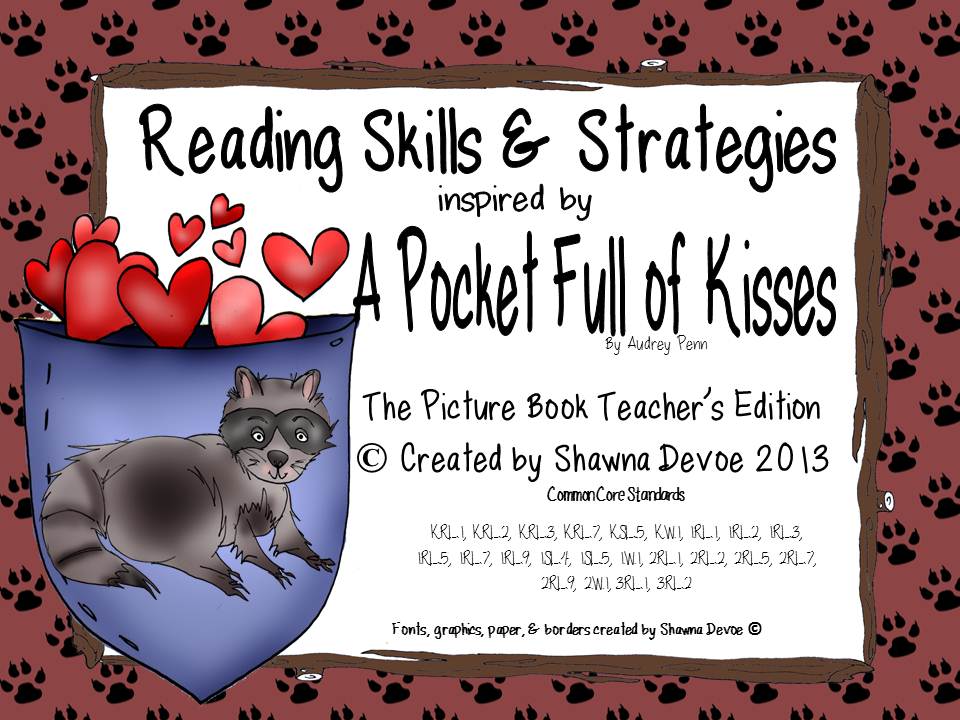
A Pocket Full of Kisses by Audrey Penn - Teaching Ideas

Chester loves his mom and the kissing hands that she always gives him. One day, Chester sees his mom give his brother a Kissing Hand and he gets so upset. Chester thought Kissing Hands were just for him and was worried that she might run out of them. Mom explains to Chester that kisses are like stars, there are enough for both him and his brother. Mom then considers Chester and decides that because he is a big brother he should have something extra special. She gives him a kiss for his pocket so he can pull it out whenever he feels like he needs an extra kiss.

Below are a list of skills, strategies and ideas that you can use to create a meaningful lesson. I have also created a packet that includes most of what I have listed below.

Reading level: 2.4
Theme/subject: family, new life experiences
Genre: fiction

Suggested Vocabulary/phrases: tenderly, motherly tone, warm and inviting, in the blink of a moment, paled, settled in

Reading skills and strategies:
  • Asking questions - {possible questions before} I wonder what the story is about. I wonder what a pocket full of kisses means. {possible questions during} I wonder why Chester got so upset when his mom gave his brother a kissing hand. {possible questions after} I wonder if Chester’s brother will want a kiss for his pocket.  **Remember to have your students answer/reflect their questions.
  • Author's point of view – Third person. Be sure to find 3 pieces of evidence to support this.
  • Author's purpose – entertain {evidence} The author uses very descriptive language. The illustrator drew beautiful pictures. Chester was happy when he got the kiss for his pocket. All of these things make an entertaining story.
  • Beginning, middle, end - {most important event from beginning} Mrs. Raccoon gave Chester a Kissing Hand.  {most important event from middle} Chester saw Mrs. Raccoon giving Ronny a Kissing Hand and he got very upset.  {most important event from end} Mrs. Raccoon gave Chester a special kiss for his pocket.
  • Cause and effect – Why does Chester want to give back his brother? Because he plays with his toys, swings on his swing and reads his books. Why could Chester hear his mother’s words in his head? Because he pressed his Kissing Hand to his cheek. Why was Chester the happiest raccoon in the forest? Because he just got a Kissing Hand from his mom. Why did Chester start to cry? Because he saw his mother giving his brother a Kissing Hand. Why did Chester think his mom didn’t love him anymore? Because he thought his mother gave his brother HIS Kissing Hand. How come mom says she won’t run out of Kissing Hands? Because when someone loves you their kisses are always there, just like the sun-rays are always there. Why does Chester’s mom think he deserves something special?  Because he is the Big Brother. Why did Chester hug his mom at the end of the story? Because she just gave him a special kiss for his pocket.
  • Character analysis - describe Chester. Describe Chester’s mom. {looks like, feelings, thoughts, character}
  • Compare & contrast – compare Chester and Ronny. Compare you and your brother or sister.
  • Connections - {possible text-to-self connections} Not liking your brother. Thinking your mom doesn’t love you.  {possible text-to-text connections} Connect this with the Kissing Hand – both are about Chester, his mom and a Kissing Hand.
  • Drawing conclusions & inferencing – Why does Chester think his mom doesn’t love him anymore when she gives Ronny a Kissing Hand? {text clues} Chester cries and asks his mom why she gave Ronny his Kissing Hand. {what I know} If my mom gives my brother (or sister) the same something special she gave me, it doesn’t feel so special anymore. {my conclusion} I think Chester thought the Kissing Hand was just for him so when she gave Ronny one it was like giving his own and it wasn’t special anymore.
  • Fact & opinion{fact} Chester’s mom gave him a Kissing Hand. Chester wanted to give Ronny back. Chester was sad when he saw his mom give Ronny a Kissing Hand. Kissing Hands will never run out. Mom gave Chester a kiss for his pocket. {opinion} Chester is mean to Ronny. Ronny is a pest. Chester is wrong for thinking his mom doesn’t love him anymore. I think Chester will lose his pocket kiss. I think mom is wrong and the sun will run out of sun-rays.
  • Main idea & details - {main idea} The story is mostly about Chester being upset that his mom gave Ronny a Kissing Hand. {details} Chester cried when his mom gave his brother a Kissing Hand. Chester asked if his mom didn’t love him anymore. Mom explained to Chester that she would never run out of Kissing Hands.
  • Plot - the turning point or climax in the story is when mom explained about the sunrays and the stars.
  • Predict – What do you think the story is about? Do you think they will give Ronny back? What do you think a Kissing Hand is? Why did Chester start to cry? What do you think the story about the stars is going to tell Chester? What was Chester right about? What do you think mom will give Chester as his something extra special?
  • Problem & solution - {problem} Chester doesn’t think Ronny should have a Kissing Hand. {solution} Mom tells Chester about the sunrays and the stars then she gives him a special kiss for his pocket.
  • Sequencing – Chester wants to get rid of Ronny. Mom gives Chester a Kissing Hand. Chester sees mom give Ronny a Kissing Hand. Chester gets upset. Mom tells the sunray and star story to Chester. Mom gives Chester a special kiss for his pocket.
  • Story elements - list title, author, characters, setting, beginning, middle, end, or problem & solution.
  • Strong thought – Mom decides that Chester does need something extra special so she gives him a kiss for his pocket. When do you think Chester might need that extra kiss in his pocket?
  • Summarize - {someone} Chester {wanted} wanted to get rid of Ronny {but} but mom said no {so} so mom gave Chester a Kissing Hand {then} then she gave Ronny a Kissing Hand. {finally} Chester was so upset about Ronny’s Kissing Hand his mom finally gave him a special kiss for his pocket.
  • Theme – moms have enough love for all their kids. 
  • Visualize – Mom gave Chester a Kissing Hand and a kiss for his pocket to help make him feel better. What does your mom do or say to you – either now or when you were younger – to make you feel better?


http://www.teacherspayteachers.com/Product/A-Pocket-Full-of-Kisses-by-Audrey-Penn-Reading-Skills-and-Strategies

Happy Reading!


2

Arthur's First Kiss by Marc Brown - Teaching Ideas


Oh dear! Arthur is so nervous about going to Muffy's Valentine's Day party because he does not want to play the kissing game! When he gets to the party Buster assures him that they won't be playing the bottle kissing game, but what Arthur doesn't know is that they will be playing a different kissing game. Muffy and Francine have it all planned out. Arthur is told that he must pick a name first, he does and it is his name. Arthur gets blindfolded and put into the garage. Francine picks next and pulls her name. Excitedly, Francine heads to the garage so she can kiss Arthur. Meanwhile, Arthur's sister DW has taken Arthur's dog Pal for a walk. She stops by the party and looks in the window. DW sees what is happening and comes to Arthur's rescue. She sends Pal into the garage and when Pal sees Arthur he gets all crazy and starts kissing Arthur. To Arthur's delight he finds that it is Pal kissing him and to Francine's dismay she hears DW yelling, "Run for your life!" Needless to say, Arthur brings home a big slice of cake for DW to thank her for saving him from having to kiss Francine.

Who doesn't love Arthur? I sure do and I know this story is sure to delight all of your students. Listed below are some skills and strategies that you can use to create activities to go with this book. I have created an Asking Questions Freebie for you to use if you students need practice with this.

Reading level: 1.8
Theme: Family, new life experiences, Valentine’s Day
Genre: Fiction, holiday fiction

Suggested Vocabulary: spin the bottle, snooping, bodyguard

Reading Skills and Strategies
  • Asking questions - {possible questions before} I wonder what the story is about. I wonder who Arthur kisses.  {possible questions during} I wonder why Francine and Muffy are only writing Arthur and Francine's name on the papers. I wonder what spin the bottle is. I wonder what game they will play. {possible questions after} I wonder if Francine is mad because she didn't kiss Arthur. **Remember to have your students answer/reflect their questions.
  • Author’s point of view - third person. Be sure to find 3 pieces of evidence to support this.
  • Author’s purpose - entertain {evidence} Everyone went to a Valentine’s Day party. Arthur was really nervous about playing spin the bottle. Pal gave Arthur lots of kisses. All these things made a very entertaining story.
  • Beginning, middle, end - {most important event from beginning} Arthur said that he was going to Muffy’s party. {most important event from middle} Francine and Muffy got papers ready for a kissing game and Arthur went first. {most important event from end} DW sent Pal in the garage to save Arthur.
  • Cause and effect – Why was Muffy having a party? Because it was Valentine’s Day. Why was Arthur nervous about going to Muffy’s party? Because he didn’t want to play the kissing game. Why did Arthur turn beet red? Because DW said he looked handsome. Why did DW want to go to the party? So she could be Arthur’s bodyguard and protect him from Francine kissing him. Why did DW take Pal for a walk? Because Arthur asked her to. Why did DW put pal through the garage at Muffy’s house? So Pal could kiss Arthur and keep Francine from kissing him. Why did Arthur bring cake home for DW? Because she protected him from Francine.
  • Character analysis - describe Arthur {looks like, feelings, thoughts, character}
  • Compare & contrast – you and Arthur.
  • Connections - {possible text-to-self connections} Going to a Valentine’s Day party at someone’s house. Being nervous about a game you don’t want to play. Having someone want to kiss you. Not wanting to kiss someone.
  • Drawing conclusions & inferencing – Why did Muffy and Francine only write Arthur and Francine on the papers? {text clues} Francine really wanted to kiss Arthur. {what I know} If only 2 names are used, only those 2 names will be drawn. {my conclusion} I think they only put those two names because Francine really wanted to kiss Arthur and if it is only their names they will be the only ones picked.
  • Main idea & details - {main idea} Francine wanted to kiss Arthur. {details} Arthur was very nervous about playing the kissing game. Francine and Muffy only put Arthur and Francine on the papers for the game. DW saved Arthur from being kissed by Francine.
  • Plot - the turning point or climax in the story is when DW takes Pal for a walk and sees what is happening at the party.
  • Predict – What do you think the story will be about? Will Arthur kiss Francine? Will DW take Pal for a walk? Do you think they will play the bottle kissing game? What do you think Francine and Muffy are doing in the corner? What do you think DW will do after she sees Arthur get a scarf put around his eyes? What do you think Pal will do?
  • Problem & solution - {problem} Arthur was nervous about going to the party because he didn’t want to play the kissing game. {solution} DW let Pal into the garage to keep Francine from kissing Arthur.
  • Sequencing – Muffy reminded everyone about her party. Arthur got ready for the party. Muffy and Francine were doing something in the corner. Arthur had to pick a name for the game first. Arthur was sent to the garage with a blindfold on. DW took Pal for a walk and peeked in the window at the party. DW sent Pal into the garage to save Arthur. Pal started kissing Arthur. DW yelled, “Run for your life” to Arthur. Arthur brought cake home for DW.
  • Story elements - list title, author, characters, setting, beginning, middle, end, or problem & solution.
  • Summarize - {someone} Francine {wanted} wanted to kiss Arthur {but} but Arthur didn’t want to kiss Francine {so} so Muffy and Francine made a game that would make Arthur have to kiss Francine. {then} When DW saw what was happening she sent Pal in to save Arthur.


https://www.teacherspayteachers.com/Product/Asking-Questions-inspired-by-Arthurs-First-Kiss-by-Marc-Brown-510661
IT'S FREE!!

Happy Reading!

4

Owen by Kevin Henkes - Teaching Ideas


Let me hear a Woot! Woot! and a see a fist pump if you love Kevin Henkes! He has the greatest characters going through the most identifiable problems. Owen is no exception. He is about to start kindergarten and must give up his blanket. Owen doesn't want to give up his blanket and Ole' Mrs. Tweezers (the nosy neighbor) is insistent that he does. His parents try all the suggestions that Mrs. Tweezers gives but it isn't until Owen's mother comes up with the best idea of all! Your students will enjoy this story, and some might even identify with Owen and his reluctance to give up his blanket.

This book has so many great teaching opportunities: life lessons, reading skills and strategies and writing. I hope you find a new idea below to help create a wonderful lesson using Owen by Kevin Henkes.

If you have no time to create a lesson and pages to go with it, I have done that for you. I created a packet filled with comprehension, cause and effect, sequencing and characterization to use with this book - see below for details. And of course I have a freebie for you too :)

Reading level: 2.5
Theme: new life experiences
Genre: humorous fiction

Suggested Vocabulary: plunger, essential, vinegar

Reading skills and strategies:
  • asking questions - {possible questions before} I wonder what this story is going to be about? Is the little boy named Owen? {possible questions during} Why won't Owen stop carrying his blanket around? I wonder what the vinegar is going to do? I wonder what Owen's mother is going to do with the blanket? {possible questions after} I wonder why Mrs. Tweezers didn't say anything about the handkerchiefs? I wnder how long Owen is going to carry those handkerchiefs? **Remember to have your students answer/reflect their questions.
  • author's point of view - third person point of view. Find 3 pieces of text evidence to support your answer.
  • author's purpose - entertain {evidence} Owen is a mouse and he is talking. Mice don't carry around blankets. Mice don't go to school. Owen became invisible because he put his blanket around his head. All these things make the book very entertaining.
  • beginning, middle, end - {most important event from beginning} Owen had a blanket that he loved and took everywhere with him. {most important event from middle} Owen's parents tried to get him to stop taking his blanket everywhere. {most important event from end} Owen's mom had a great idea and cut Owen's blanket into small handkerchiefs so he could carry them in his pocket.
  • cause and effect - Why did Owen love his blanket with all his heart? because he had it since he was a baby. Why did Owen put Fuzzy in his pajama pants? because he did not want the Blanket Fairy to come and take Fuzzy away. Why did Owen's father put vinegar on the corner of Owen's blanket? because they were trying to get Owen to stop carrying the blanket. Why did Owen rub his blanket in his sandbox? because he was trying to get rid of the smelly corner. Why did Owen bury his face in Fuzzy and not stop crying? because his parents told him that he could not bring Fuzzy to school. Why did Owen finally stop crying? because his mom had a great idea, she cut Fuzzy into small squares so he could carry them in his pocket.
  • characterization - describe Owen {looks like, feelings, thoughts, character}
  • classify & categorize - things that belong at school and things that belong at home.
  • compare & contrast - You and Owen. Your special "thing" and Owen's blanket.
  • connections - {possible text-to-self connections} having a blanket or stuffed animal that you carry around all the time.  Having your parents try to take away your special blanket/stuffed animal. Wanting to bring something to school with you.
  • drawing conclusions & inferencing - How do you think the blanket made Owen feel? {text clues} Owen carried that blanket everywhere. Owen played with the blanket all the time. {what I know} I have a _____ that makes me feel safe when I am nervous or scared. {my conclusion} I think the blanket made Owen feel safe and happy.
  • main idea & details - {main idea} Owen has a blanket and he won't get rid of it. {details} Owen didn't leave his blanket under his pillow when his parents tell him a Blanket Fairy will come and take it and leave him a special surprise. Owen didn't care that one corner of his blanket was smelly, he just picked another corner. He started to cry when he was told he couldn't take the blanket to school with him.
  • plot - the turning point or climax in the story was when Owen's mom had a great idea and started to cut and sew the blanket.
  • predict - What do you think the story is about? Why do you think Mrs. Tweezer's is telling Owen's parents about the Blanket Fairy? Do you think Owen will put his blanket under his pillow? What do you think the Blanket Fairy will leave Owen? Why do you think Owen is rubbing the smelly corner of the blanket in the sandbox? Do you think Owen is going to bring Fuzzy to school? What do you think Owen's moms good idea is? Why do you think Mrs. Tweezers didn't say anything anymore?
  • problem & solution - {problem} Owen's parents were trying to get Owent to stop carrying his blanket around. {solution} Owen's mother cut and sewed he blanket so it wasn't a blanket anymore, they were little handkerchiefs he could carry in his pocket.
  • sequencing - Owen had a blanket he loved. Mrs. Tweezers told Owen's parents about the Blanket Fairy. Owen didn't put his blanket under his pillow. Mrs. Tweezers told Owens parents about the vinegar trick. Owens father put vinegar on Owen's favorite corner of Fuzzy. Owen picked a new favorite corner and rubbed the smelly one in the sandbox. Owen's parents told him that he could not bring Fuzzy to school with him. Owen buried his face in Fuzzy and wouldn't stop crying. Owen's mother had a great idea. She cut and sewed Fuzzy into a bunch of handkerchiefs. Owen carried a handkerchief with him everywhere he went.
  • story elements - list title, author, character's, setting, beginning, middle, end, or problem & solution. 
  • summarize - {someone} Owen {wanted} wanted to take his blanket to school with him {but} but his parents said he couldn't. {so}  His mom had a great idea {then} which meant cutting his blanket into many small pieces. {finally} Owen could finally take his blanket everywhere he wanted.

ACTIVITY PACKET
http://www.teacherspayteachers.com/Product/Reading-Skills-Strategies-Packet-inspired-by-Owen-by-Kevin-Henkes
$ PACKET $


PREDICT FREEBIE

http://www.teacherspayteachers.com/Product/Predicting-Freebie-inspired-by-Owen-by-Kevin-Henkes

IT'S FREE!!
Happy teaching!

0

Arthur Goes To Camp by Marc Brown - Teaching Ideas


If you have any reluctant campers in your midst, this is a fun book to read to them. Arthur is a very reluctant camper, he hates everything about camp. All his letters home are about how homesick he is. There are jokes played on him and his fellow camp mates and Arthur decides it is time to run away from camp. Arthur's other camp mates, Buster and The Brain, figure out who is playing the jokes on them so they make a plan to get back at the other camp. The day Arthur runs away is the day of the big scavenger hunt and the day Buster and The Brain put their plan into action. Their plan was a success the other camp gets scared and can't finish the scavenger hunt. Arthur gets lost as he runs away and wonders right into the middle of the scavenger hunt. Arthur takes out his flashlight to see where he is which is all that his camp mates need to win the scavenger hunt. All his camp mates cheer him and Arthur is happy, he now LOVES camp.

Reading level: 2.7
Theme: new life experiences
Genre: humorous fiction      

Suggested Vocabulary: fond, scavenger hunt, eager, flabby, phase one, nudged

Reading skills and strategies:
  • asking questions - {possible questions before}Where did Arthur go to camp? Is Arthur going to have fun? Why is Arthur in the woods {possible questions during} Why does Arthur not like camp? What is the name of Arthur's camp? How come the girls' counselor is nicer than the boys' counselor? Are they really not going to get any dessert all camp? Why does Muffy need electricity to brush her teeth? Why did Arthur scream when the frogs jumped around his room? Why are the girls winning at everything? Who really took the boys clothes? Why were all the campers too scared to tell ghost stories? Why was Arthur running away from camp? What was The Brain's plan? What was The Brain wearing to look like a bear? Is Arthur going to get lost?  {possible questions after} Was Arthur lost? Were the other campers still in the trees? Why does Arthur like camp now? Will Arthur have fun at camp the next time he goes?
  • author's point of view - 3rd person
  • author's purpose - entertain{evidence}animals can't talk, The Brain wore a mink coat to pretend like he was a bear, the picture of all the frogs in the boys cabin jumping around - all these things are silly and make the book entertaining.
  • beginning, middle, end - {most important event from beginning} Arthur gets to camp and his counselor is mean. {most important event from middle} Buster and Brain figure out who is scaring them. {most important event from end} Arthur helps the campers win the scavenger hunt.
  • cause and effect - Why does Arthur and his friends think the Camp Horsewater kids will win the scavenger hunt? because the look like they are in shape. Why does the boys' counselor say they get no desert? because he thinks they look out of shape. Why does Buster and The Brain stake out the woods? because they want to see what is making all the scary noises. Why do the Camp Meadowcroak kids win the scavenger hunt? because Arthur has the flashlight they need to win. Why do the Camp Horsewater kids get scared? because Buster and his friends scare them by dressing up as a bear. Why does Arthur run away from camp? because he hates camp. Why does Arthur decide he likes camp? because he helped his friends win the scavenger hunt and they cheered for him.
  • characterization - describe Arthur {looks like, feelings, thoughts, character}
  • compare & contrast - Horsewater campers to Meadowcroak campers 
  •  connections- {possible text-to-self connections} Going to camp. Hating camp. Playing games at camp. Being scared at camp. {possible text-to-text connections} The following books are about going to camp: The Berenstain Bears Go to Camp by Stan Berenstain and Jan Berenstain, Curious George Goes Camping (Curious George 8x8) by Margret Rey and H. A. Rey, P. J. Funnybunny Camps Out (Step into Reading) by Marilyn Sadler and Roger Bollen
  • main idea & details - {main idea} Arthur doesn't like camp. {details} Arthur writes letters to his family telling them how much he hates camp. Arthur screams when they find frogs in their cabin. Arthur decides to run away.
  • plot - the turning point, or climax in the story is when The Brain and Buster figure out who is scaring them.
  • predict - Do you think Arthur is going to have a good time at camp? Who do you think is scaring the campers? Is Arthur going to get lost? Who do you think is going to win the scavenger hunt?
  • problem & solution - {problem} Arthur doesn't like camp. {solution} He helps his friends win the scavenger hunt so Arthur now Arthur loves camp.
  • sequencing - Arthur tells his parents he does not want to go to camp. Arthur meets at the bus for camp. They drive past Camp Horsewater and see all the campers in great shape. Arthur and the others get to Camp Meadowcroak. The girls' counselor is nice and the boys' counselor is mean. The boys find frogs in their cabin. The girls beat the boys in all the activities. A smoke bomb got thrown into the girls tent. Someone took all the boys clothes. The girls and boys heard strange noises in the woods and were too scared to tell ghost stories. Buster and The Brain found out that is was the Camp Horsewater kids scaring them. They made a plan for the scavenger hunt. Arthur runs away from camp. They scare the Camp Horsewater kids by pretending to be a bear. They find almost all the scavenger stuff except a flashlight. Arthur gets lost in the woods as he is running away so he turns on his flashlight. All the kids cheer for Arthur because he has the flashlight that helps them win the scavenger hunt. Arthur now loves camp.
  • story elements - list title, author, character's, setting, beginning, middle, end, or problem & solution.
  • summarize - {someone}Arthur didn't {wanted} want to go to camp {but} but his parents made him {so} so he decided to run away. {then} Then he got lost in the woods and when he {finally} finally turned on his flashlight to help him he had the last item on the list that helped his camp win the scavenger hunt.
Here is a FREEBIE for you to use with this book. Click the picture to get the beginning, middle, end activity.


I have created a True False Comprehension game for this book also. There are 36 questions, one spinner, one game board, one direction sheet and one title page, everything you need to create a comprehension file folder game. There are 24 questions dealing with the comprehension of the story and 12 questions that deal with story elements (setting, character, problem, solutions, comparison, character description, genre, etc.).


http://www.teacherspayteachers.com/Product/True-False-Comprehension-Game-inspired-by-Arthur-Goes-To-Camp-by-Marc-Brown
for the game...


Happy reading!!

12